


Tired of copying and pasting Cilium Network Policies? Try clusterwide policies.
Imagine this: your Kubernetes cluster is bustling with activity. Dozens, perhaps even hundreds, of namespaces are running independently of one another, each with its own microservices. One team needs internet access to build AI vectors and download AI models. Another team is subject to stricter security requirements due to sensitive data. How do you keep this organized without getting lost in a tangled mess of Cilium Network Policies?
Teams often struggle with writing an endless number of nearly identical network policies. Every time a new namespace is created, the same routine starts all over again. Sometimes it's even included in the Scrum Definition of Done! Surely there must be an easier way?
Fortunately, there is a much simpler way. The solution: Cilium Cluster-wide Network Policies (CCNPs) combined with smart namespace labeling. This eliminates redundancy and the inconsistencies that come with it.
Policy spaghetti
The pitfall of repetition
- Do you keep seeing the same internet access rules over and over again? What a waste of time.
- Management and Overview: Keep It Simple
Imagine having hundreds of these policies. Making a quick change is difficult. The easiest way is to do this centrally, preferably using GitOps with, for example, Argo CD. - Prone to errors: a typo is all it takes
One wrong digit in an IP address or a typo in a port number, and the connection stops working—or worse yet: it’s wide open.
Simplify management: the power of CCNPs and namespace labels
Cilium Cluster-wide Network Policies (CCNPs) define policies for your entire cluster rather than a single namespace. And the great thing is: you can configure these CCNPs to respond to labels applied to namespaces. Here’s how it works:
➜ ~ kubectl create namespace hello-world
namespace/hello-world created
➜  ~ kubectl run nginx -n hello-world --image docker.io/nginxdemos/hello --image-pull-policy=IfNotPresent --port 80
pod/nginx created
➜  ~ kubectl -n hello-world expose pod nginx --type LoadBalancer
service/nginx exposed
➜  ~ kubectl -n hello-world get svc
NAME    TYPE           CLUSTER-IP     EXTERNAL-IP    PORT(S)        AGE
nginx   LoadBalancer   10.43.67.208   192.168.4.51   80:30715/TCP   61s
➜  ~ curl http://192.168.4.51 | grep "<title>"
  % Total    % Received % Xferd  Average Speed   Time    Time     Time  Current
                                 Dload  Upload   Total   Spent    Left  Speed
100 12108    0 12108    0     0   955k      0 --:--:-- --:--:-- --:--:--  985k
<title>Hello World</title>
Copy code
Deny-all policy
Let's start with a secure baseline. Block all incoming and outgoing traffic by applying a Cilium Network Policy that matches all traffic. You can implement this mechanism in several ways: per namespace, with a CCNP (Cilium Cluster-wide Network Policy), or via Enforcement Mode "always." (https://docs.cilium.io/en/latest/security/policy/intro/).
deny-all.yaml:
---
apiVersion: "cilium.io/v2"
kind: CiliumClusterwideNetworkPolicy
metadata:
  name: "deny-all"
spec:
  description: "Make sure namespace is locked"
  endpointSelector:
    matchExpressions:
    - key: io.kubernetes.pod.namespace
      operator: In
      values:
      - hello-world
  ingress:
  - {}
  egress:
  - {}


➜ ~ kubectl apply -f deny-all.yaml
ciliumclusterwidenetworkpolicy.cilium.io/deny-all created
Copy code
Endpoints listen and locate your app
Label the namespace with allow-ingress-port-80=true. You'll need this label in the Cilium Cluster-wide Network Policy endpoint selector.
➜  ~ kubectl label namespace hello-world allow-ingress-port-80=true
namespace/hello-world labeled


➜ ~ kubectl -n hello-world describe ciliumendpoint nginx
Name:         nginx
Namespace:    hello-world
Labels:       run=nginx
API Version:  cilium.io/v2
Kind:         CiliumEndpoint
...
Status:
  Encryption:
  External - Identifiers:
    k8s-namespace:          hello-world
    k8s-pod-name:           nginx
    Pod - Name:             hello-world/nginx
  Id:                       47
  Identity:
    Id:  34739
    Labels:
      k8s:io.cilium.k8s.namespace.labels.allow-ingress-port-80=true
      k8s:io.cilium.k8s.namespace.labels.kubernetes.io/metadata.name=hello-world
      k8s:io.cilium.k8s.policy.cluster=default
      k8s:io.cilium.k8s.policy.serviceaccount=default
      k8s:io.kubernetes.pod.namespace=hello-world
      k8s:run=nginx
...
Copy code
The NGINX pod is known as a Cilium Endpoint. The namespace labels, automatically prefixed with io.cilium.k8s.namespace.labels, are associated with the endpoint. You can use these labels in the Network Policy endpointSelector.
Create a Cilium Cluster-wide Network Policy
Due to the deny-all policy, the container is now inaccessible:
➜  ~ curl --connect-timeout 5 -I http://192.168.4.51
curl: (28) Failed to connect to 192.168.4.51 port 80 after 5006 ms: Timeout was reached


➜  ~ kubectl -n kube-system exec ds/cilium -c cilium-agent -- cilium monitor --related-to 47
Press Ctrl-C to quit
time="2025-06-26T21:18:31Z" level=info msg="Initializing dissection cache..." subsys=monitor
Policy verdict log: flow 0x0 local EP ID 47, remote ID world, proto 6, ingress, action deny, auth: disabled, match none, 192.168.4.229:51956 -> 10.42.0.251:80 tcp SYN
xx drop (Policy denied) flow 0x0 to endpoint 47, ifindex 4, file bpf_lxc.c:2091, , identity world->34739: 192.168.4.229:51956 -> 10.42.0.251:80 tcp SYN
Policy verdict log: flow 0x0 local EP ID 47, remote ID world, proto 6, ingress, action deny, auth: disabled, match none, 192.168.4.229:51956 -> 10.42.0.251:80 tcp SYN
xx drop (Policy denied) flow 0x0 to endpoint 47, ifindex 4, file bpf_lxc.c:2091, , identity world->34739: 192.168.4.229:51956 -> 10.42.0.251:80 tcp SYN
Copy code
Now create a Cilium cluster-wide network policy that takes effect only if a namespace has a specific label. In this example: allow-ingress-port-80: “true”.
---
apiVersion: "cilium.io/v2"
kind: CiliumClusterwideNetworkPolicy
metadata:
  name: "allow-ingress-port-80"
spec:
  description: "Clusterwide Network to allow ingress http traffic"
  endpointSelector:
    matchLabels:
      io.cilium.k8s.namespace.labels.allow-ingress-port-80: "true"
  ingress:
  - fromEntities:
    - world
    toPorts:
    - ports:
      - port: "80"
        protocol: TCP


➜ ~ kubectl apply -f allow-ingress-port-80.yaml
ciliumclusterwidenetworkpolicy.cilium.io/allow-ingress-port-80 created
Copy code
The result
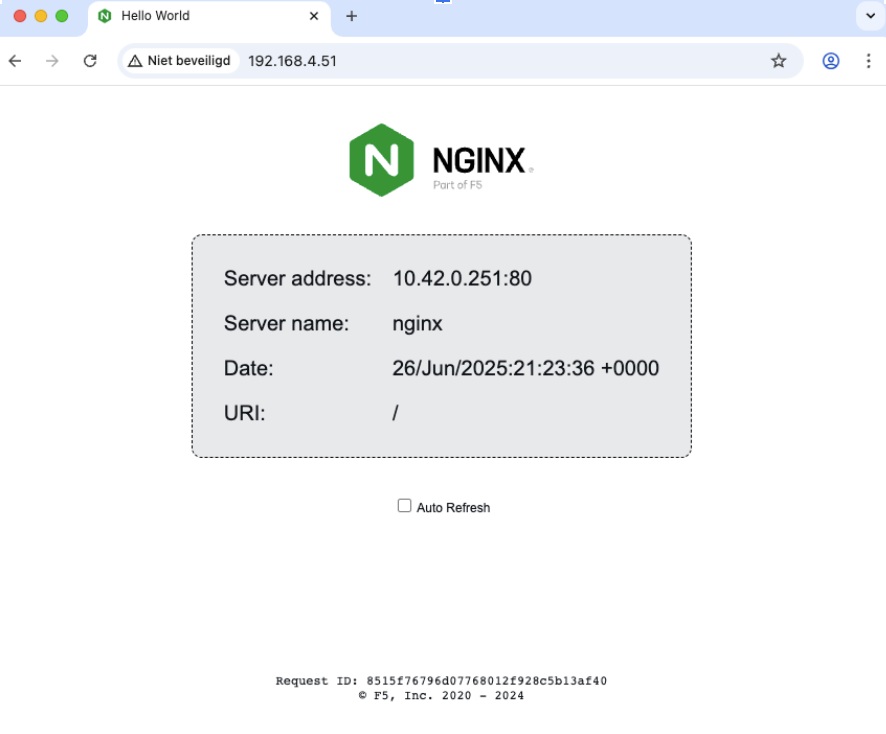
The Cilium Cluster-wide Network Policy now grants access to the pod in the namespace. Time to test this:
➜  ~ curl http://192.168.4.51 | grep "<title>"
  % Total    % Received % Xferd  Average Speed   Time    Time     Time  Current
                                 Dload  Upload   Total   Spent    Left  Speed
100 12108    0 12108    0     0  2769k      0 --:--:-- --:--:-- --:--:-- 2956k
<title>Hello World</title>
Copy code
References
And that’s how it works: Cilium Cluster-wide Network Policies (CCNPs) combined with smart namespace labeling. Imagine using a similar approach to replace complex, namespace-bound network policies for, say, Prometheus, Fluentd, or other tools.
References
- https://docs.cilium.io/en/stable/gettingstarted/terminology/
- https://docs.cilium.io/en/stable/network/kubernetes/policy/#network-policy
- https://docs.cilium.io/en/stable/network/kubernetes/policy/#ciliumclusterwidenetworkpolicy
To learn how SUE sets up and manages Kubernetes clusters, visit the Kubernetes page. The Kubernetes guide covers everything from setting up your first cluster to production.
- Tired of copying and pasting Cilium Network Policies? Try clusterwide policies.
- Policy spaghetti
- Simplify management: the power of CCNPs and namespace labels
- Deploy an example application
- Deny-all policy
- Endpoints listen and locate your app
- Create a Cilium Cluster-wide Network Policy
- The result
- References
- Tired of copying and pasting Cilium Network Policies? Try clusterwide policies.
- Policy spaghetti
- Simplify management: the power of CCNPs and namespace labels
- Deploy an example application
- Deny-all policy
- Endpoints listen and locate your app
- Create a Cilium Cluster-wide Network Policy
- The result
- References


